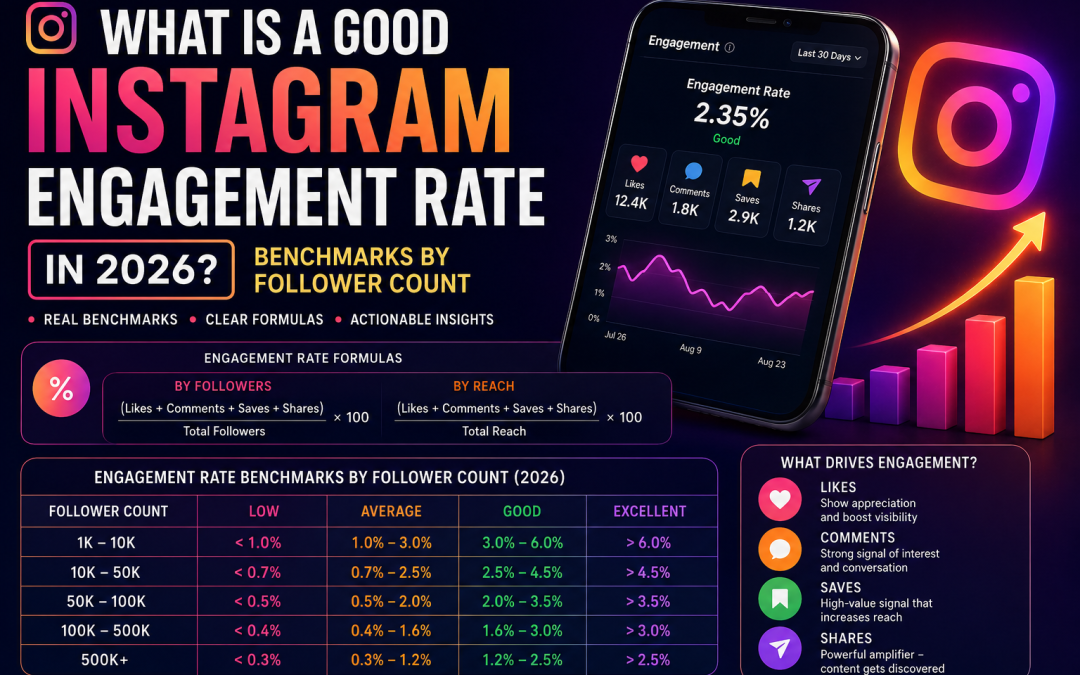
If your Instagram reach changes from one post to the next, it can feel as though a mysterious algorithm is deciding who succeeds and who disappears.
The reality is more complicated — and more useful.
Instagram does not have one universal algorithm. It uses many machine-learning systems to predict what each person is most likely to find interesting across Feed, Reels, Stories, Explore, Search and other surfaces.
Meta said in 2025 that Instagram’s recommendation infrastructure had grown to more than 1,000 machine-learning models. In January 2026, Meta also reported that 75% of Instagram recommendations in the United States were coming from original posts during Q4 2025. Those two facts tell us a lot about where Instagram is heading: deeper personalization, more AI-driven discovery and stronger preference for original content.
Quick answer: In 2026, the clearest creator-facing Instagram ranking signals are watch time, likes per reach and sends per reach. Likes are slightly more important when Instagram is deciding what to show your existing audience, while sends are especially important when deciding whether content should reach people who do not already follow you.
Those signals do not operate alone. Originality, recommendation eligibility, a viewer’s past behavior, relationship history, content topic and the surface being ranked all affect distribution.
- What the Instagram algorithm actually is
- The three biggest ranking signals
- How Feed ranking works
- How the Reels algorithm works
- How Stories are ranked
- How Explore works
- How Instagram Search works
- Why original content matters more in 2026
- Where paid engagement fits
- How to improve your ranking signals
- Instagram algorithm myths
- Frequently asked questions
What Is the Instagram Algorithm in 2026?
The phrase “Instagram algorithm” is useful shorthand, but technically misleading.
Instagram operates a collection of ranking and recommendation systems. Each system has a different job.
| Instagram surface | Main purpose | What the system is trying to predict |
|---|---|---|
| Feed | Personal relevance | Which posts from followed accounts and recommendations you are most likely to care about and interact with |
| Reels | Entertainment and discovery | Which videos will hold attention and be worth liking or sending to others |
| Stories | Relationships | Whose Stories you are most likely to open, like or reply to |
| Explore | Discovery | Which unfamiliar posts match your interests and are likely to satisfy you |
| Search | Intent matching | Which accounts, posts and topics best match what you typed and your previous activity |
Meta’s engineering documentation describes these systems as prediction engines. They gather possible content, estimate how likely you are to take different actions, assign scores, apply safety and diversity rules, then rank the results.
In other words, Instagram is constantly asking something like:
“Given what we know about this person, what are they most likely to watch, enjoy, share or interact with next?”
Source: Meta — Instagram Feed Ranking System Card and Meta Engineering — Scaling Instagram’s recommendation system.
The 3 Instagram Ranking Signals That Matter Most in 2026
Instagram head Adam Mosseri identified three signals creators should pay particularly close attention to:
Mosseri explained that likes are slightly more important for connected reach — people who already follow you — while sends are slightly more important for unconnected reach, meaning people who do not follow you yet.
This distinction is extremely important because it explains why a post can perform well with followers but fail to break into new audiences.
1. Watch Time
Watch time tells Instagram whether people actually stayed with your content instead of immediately moving on.
For Reels, this means holding attention. For a carousel or static post, time spent reading, swiping or examining the content can also signal interest.
A strong hook can earn the first second. The content itself has to earn the rest.
2. Likes per Reach
Instagram is not simply looking at the raw number of likes. The useful concept is likes relative to how many people saw the content.
If 100 people see a post and 20 like it, that produces a very different response rate from 20 likes after 10,000 people were reached.
Likes appear to be particularly useful for understanding whether content resonates with your existing audience.
3. Sends per Reach
A send happens when somebody shares your post or Reel privately with another person.
This is powerful because sending content requires more intent than simply tapping Like. It suggests the viewer thought, “Someone else needs to see this.”
That is why sends are especially relevant when Instagram evaluates whether content may appeal to people outside your current follower base.
Source: Adam Mosseri’s January 2025 ranking explanation, reported by Social Media Today.
Are Comments and Saves Still Important?
Yes — but there is an important nuance.
Comments and saves were not included in Mosseri’s three headline signals, but Meta’s own Feed system documentation shows that its ranking models predict multiple possible actions, including likes, saves, comments, profile taps and video viewing.
So it would be wrong to say comments and saves “do not matter.” A better interpretation is that watch time, likes and sends are currently the clearest high-level signals Instagram tells creators to prioritize.
If you use services such as Instagram Saves for account presentation or campaign support, treat them as supplemental metrics rather than a substitute for genuine audience interest.
How the Instagram Feed Algorithm Works
Feed is designed to show a personalized mix of content from accounts you follow and recommended content Instagram predicts you will care about.
Meta has described Feed ranking as a multi-step process:
- Candidate gathering: Instagram collects posts that could potentially be shown.
- Filtering: Content that violates policies or fails eligibility checks can be removed or demoted.
- Prediction: Models estimate how likely you are to watch, like, save, comment, tap a profile or take another meaningful action.
- Scoring: Those predictions are combined into ranking scores.
- Re-ranking: Additional rules create variety so one creator or media type does not dominate your Feed.
The key point is personalization.
There is no universal list where Instagram says, “Post A is number one for everybody.” The same post can rank very highly for one person and barely appear for another because their interests and relationship histories differ.
What Helps Feed Reach?
- Content your existing followers consistently respond to.
- Strong like rates among reached followers.
- Time spent consuming the post.
- Sends and shares.
- A history of interaction between the viewer and creator.
- Clear topical relevance.
- Original, recommendation-eligible content.
If visible engagement is part of your broader social-proof strategy, SocialMediaGram offers Instagram Likes and Automatic Instagram Likes. However, those services should not be confused with a guarantee of organic Feed distribution. Instagram’s ranking systems evaluate genuine user behavior and many other signals beyond a displayed metric.
How the Instagram Reels Algorithm Works in 2026
Reels is primarily a discovery and entertainment surface.
Unlike Stories, which focus heavily on people you already know, Reels is built to introduce users to creators and content they may never have seen before.
This makes Reels particularly important for growth.
The core idea is simple:
Instagram wants to recommend Reels that people are likely to watch and enjoy enough to keep watching, like or send to somebody else.
What Reels Ranking Looks At
- Watch time: Does the Reel hold attention?
- Likes per reach: Do viewers actively signal that they enjoyed it?
- Sends per reach: Is the Reel compelling enough to share privately?
- Viewer interests: Has the person previously interacted with similar topics?
- Originality: Is this content original or meaningfully transformed?
- Recommendation eligibility: Is the content suitable to be shown to people who did not choose to follow the account?
Why a Reel Can Suddenly Take Off
Instagram has described recommendation systems that expose eligible content to audiences predicted to enjoy it, learn from the response and expand distribution when performance is strong.
This means your follower count is not necessarily a hard ceiling on Reels reach.
A smaller account can create a Reel that travels well beyond its existing audience if the content performs strongly with the people Instagram tests it against.
This is also why an account with 100,000 followers can publish a Reel that performs poorly: follower count does not force people to watch.
Do Reel Views Help the Algorithm?
Views and watch time are not the same thing.
A view tells you that a Reel was viewed according to Instagram’s reporting rules. Watch time tells you how much attention the content actually held.
That distinction matters.
SocialMediaGram’s Instagram Reel Views service can be used by customers who want a stronger visible view count or social-proof metric, but a purchased view count should not be interpreted as guaranteed organic watch-time retention or guaranteed algorithmic reach.
Trial Reels Are Worth Testing
Instagram has made Trial Reels available broadly so creators can show a Reel to non-followers first and see how it performs before deciding whether to share it more widely.
Meta reported that, among creators who began posting Reels more often after trying Trial Reels, 80% saw an increase in Reels reach from non-followers. That does not mean Trial Reels guarantee growth, but they are a useful testing tool because they let creators evaluate an idea against a discovery audience.
Source: Meta — Inspiring Creativity That Brings People Together.
How the Instagram Stories Algorithm Works
Stories work differently because they are primarily designed to strengthen existing relationships rather than maximize discovery.
Mosseri has identified three particularly important predictions for Stories:
- How likely you are to tap into a person’s Story.
- How likely you are to like that Story.
- How likely you are to reply to the Story with a message.
Instagram also learns from relationship history: whose Stories you normally watch, who you message and which accounts you repeatedly interact with.
This explains why the same few people often appear near the front of your Story tray.
How to Improve Story Ranking
- Post content your existing audience has a reason to open.
- Use polls, questions and interactive stickers when they genuinely fit.
- Create timely behind-the-scenes content.
- Encourage natural replies and conversations.
- Avoid flooding followers with low-value slides just to increase volume.
Stories are usually better for relationship depth than mass discovery.
Source: Mosseri’s Stories ranking explanation, reported by Social Media Today.
How Instagram Explore Works
Explore is one of Instagram’s largest recommendation systems.
Its job is to find content from outside your normal network that closely matches your interests.
Meta’s engineering team has described Explore as a multi-stage funnel:
- Retrieval: Gather potentially relevant candidates.
- First-stage ranking: Quickly narrow a large candidate pool.
- Second-stage ranking: Apply more sophisticated models to the strongest candidates.
- Final re-ranking: Produce a personalized set of recommendations.
Instagram’s systems use previous behavior to infer interests. If you repeatedly watch, like and send content about fitness, travel or interior design, the system learns that those topics are more likely to satisfy you.
This is why Explore pages look completely different from person to person.
Meta also says its recommendation technology can analyze content deeply enough to understand themes even when the caption does not explicitly describe them.
Source: Meta Engineering — Scaling the Instagram Explore recommendations system.
How Instagram Search Works
Search is different from Feed or Reels because the user gives Instagram an explicit clue about intent: the words they type.
Instagram’s published Search guidance identifies three broad signal groups:
- The search text: Instagram tries to match the query with relevant usernames, names, bios, captions, hashtags and places.
- The searcher’s activity: Accounts followed, posts viewed and previous interactions can personalize results.
- Popularity and relevance: When many potential matches exist, engagement and popularity signals can help rank them.
For creators and businesses, this means Instagram SEO is real.
Basic Instagram SEO Checklist
- Use a profile name that clearly describes who you are or what you do.
- Include relevant keywords naturally in your bio.
- Use descriptive captions rather than vague one-liners on every post.
- Make the topic of a Reel obvious in speech, on-screen text and caption context.
- Use relevant hashtags where they genuinely help categorize the content.
- Keep your niche and account positioning understandable.
Instagram’s public Search explanation is older than some of its current recommendation documentation, so individual weighting may evolve. But the principle remains useful: make it easy for Instagram to understand what your account and content are about.
Why Original Content Matters More in 2026
One of the clearest Instagram trends heading into 2026 is the increasing priority given to original creators.
Meta reported in January 2026 that 75% of recommendations on Instagram in the United States were coming from original posts during Q4 2025.
Then, in April 2026, Instagram expanded its originality enforcement so accounts that regularly aggregate other people’s photos and carousels can lose recommendation eligibility across discovery surfaces.
The platform has been moving in this direction for years:
- Original posts can replace identical reposts in recommendations.
- Reposted content may point users back to the original creator.
- Accounts that repeatedly aggregate other people’s work can become less recommendable.
- Content with meaningful transformation, commentary, editing or original perspective is treated differently from low-effort duplication.
2026 takeaway: Reposting somebody else’s content with a tiny edit is a much weaker strategy than creating something recognizably yours. Originality is no longer just an ethical or branding issue — it can directly affect recommendation eligibility.
Sources: Meta — 2026: AI Drives Performance and Social Media Today — Instagram’s April 2026 originality update.
Recommendation Eligibility: The Part Creators Often Miss
Good engagement does not automatically mean a post is eligible to be recommended broadly.
Instagram applies Recommendation Guidelines that are stricter than the basic Community Guidelines because recommended content is shown to people who did not choose to follow the account.
Content can remain on Instagram yet still be unsuitable for recommendation.
Examples can include certain sensitive material, low-quality publishing, engagement bait, misleading content and unoriginal content that adds little value.
Instagram’s guidance also says accounts can become harder to recommend when they repeatedly use misleading practices to build a following.
This is why creators should separate two questions:
“Is this allowed on Instagram?”
and
“Is Instagram likely to recommend this to strangers?”
Those are not always the same thing.
Source: Meta — Recommendation Guidelines.
Does Follower Count Affect the Instagram Algorithm?
Follower count can matter indirectly because a larger established audience creates more opportunities for content to receive early interaction.
But follower count itself is not one of the three top ranking signals Mosseri highlighted.
This means:
- A large account can still get poor reach.
- A small account can still reach large numbers of non-followers.
- Content performance matters more than simply possessing a large follower number.
Follower count can still influence social proof and first impressions. If you are considering increasing that visible metric, read our detailed guide Is It Safe to Buy Instagram Followers in 2026? before deciding whether it fits your goals.
SocialMediaGram also offers Instagram Followers for customers whose objective is profile presentation and visible social proof. We do not recommend treating follower count as an algorithm shortcut.
Can Paid Likes, Views or Shares Make the Algorithm Rank You?
This deserves a clear answer because many social-media growth articles blur the difference between visible metrics and organic ranking behavior.
No paid metric should be presented as a guaranteed way to manipulate Instagram’s recommendation system.
Instagram’s models evaluate user behavior, relationships, content quality, recommendation eligibility, watch time, response rates and many other predictions.
| Service / metric | What it can support | What it cannot guarantee |
|---|---|---|
| Instagram Followers | Visible follower count and profile social proof | Organic reach, genuine audience interest or algorithmic distribution |
| Instagram Likes | Visible engagement and social proof on a post | That real viewers will continue liking or that Instagram will expand organic reach |
| Instagram Reel Views | Visible Reel view count | High audience retention, average watch time or non-follower recommendations |
| Instagram Shares | Share activity associated with a post or Reel | That genuine users will privately send the content at a high organic rate |
| Automatic Instagram Likes | Consistent visible engagement across future posts | Organic audience retention, viral reach or recommendation eligibility |
Where SocialMediaGram Fits
SocialMediaGram’s services are best understood as social-proof and presentation tools, not a replacement for content strategy.
If you want stronger organic reach, focus first on the signals Instagram itself talks about: watch time, genuine likes, sends, originality, recommendation eligibility and content relevance. If you also want to strengthen visible profile or post metrics, you can combine that organic strategy with selected SocialMediaGram services.
How to Improve Your Instagram Ranking Signals in 2026
1. Create for Watch Time, Not Just the First View
A click or initial view is only the beginning.
Your goal should be to make the next second worth watching.
- Open with the point quickly.
- Remove unnecessary intros.
- Use clear pacing and readable on-screen text.
- Deliver the promised value.
- Study where viewers drop off and test stronger versions.
2. Make Content Worth Sending
If non-follower reach matters to you, ask:
“Would somebody send this to a friend?”
Useful formats often include:
- Relatable observations.
- Strong opinions backed by evidence.
- Practical checklists.
- News people want to discuss.
- Humor that feels specific to a community.
- Advice that solves an immediate problem.
3. Give Existing Followers Reasons to Like
Likes still matter, especially for connected reach.
But chasing likes through generic engagement bait is not the goal.
Instead, learn which topics consistently earn positive reactions from the people who already follow you.
4. Make Originality Obvious
Use your own:
- Footage.
- Analysis.
- Voice.
- Examples.
- Data.
- Design.
- Commentary.
If you work with third-party material, add meaningful transformation rather than simply reposting it.
5. Optimize for the Surface You Want to Win
Do not use the same strategy everywhere.
| If your goal is… | Prioritize… |
|---|---|
| Reach current followers | Feed relevance, likes, consistency and relationship history |
| Reach new people | Reels, sends, watch time, originality and recommendation eligibility |
| Strengthen community | Stories, replies, DMs and interactive content |
| Appear in topic searches | Clear keywords, profile positioning, captions and topical consistency |
| Reach Explore | Strong topic relevance and performance with people interested in similar content |
6. Use Insights to Separate Follower Reach From Non-Follower Reach
Do not judge a post only by total likes.
Look at:
- Views and reach.
- Follower versus non-follower reach.
- Average watch time where available.
- Likes relative to reach.
- Sends and shares.
- Profile visits.
- Follows generated by the content.
If you use supplemental services such as Instagram Reach or Instagram Impressions, keep your paid activity separate from your organic analysis so you can still understand how your real audience is responding.
Instagram Algorithm Myths to Stop Believing in 2026
Myth 1: “Instagram Has One Algorithm”
False. Feed, Stories, Reels, Explore, Search and other surfaces use different ranking systems and models.
Myth 2: “More Followers Automatically Means More Reach”
False. A larger follower base can create more opportunities for engagement, but follower count does not guarantee distribution.
Myth 3: “Likes Are Dead”
False. Mosseri specifically lists likes among the three biggest ranking signals, with likes slightly more important for connected reach.
Myth 4: “Comments Are the Most Important Signal”
Not according to Instagram’s current headline guidance. Comments may still contribute to engagement and time spent, but watch time, likes and sends are the three signals Mosseri singled out.
Myth 5: “Hashtags Make a Post Viral”
No. Hashtags can help Instagram understand and categorize content and can support Search, but they do not compensate for weak content or poor audience response.
Myth 6: “Posting at the Perfect Time Guarantees Reach”
No. Timing can affect how quickly your existing audience sees a post, but there is no universal magic hour that overrides content relevance and performance.
Myth 7: “A Shadowban Explains Every Reach Drop”
No. Reach can fall because of audience saturation, weaker retention, fewer sends, recommendation ineligibility, competition, topic changes or normal ranking variation. Treat “shadowban” as a hypothesis to investigate, not an automatic diagnosis.
What Changed Most in the Instagram Algorithm by 2026?
If we had to summarize the direction of Instagram ranking in one sentence, it would be:
Instagram is becoming more personalized, more AI-driven, more discovery-focused and more protective of original content.
The biggest developments behind that conclusion are:
- 1,000+ ML models: Instagram’s ranking infrastructure has become highly specialized rather than relying on one simple formula.
- Originality: Meta said 75% of U.S. Instagram recommendations were coming from original posts in Q4 2025.
- Stronger aggregator restrictions: Instagram expanded originality protections to photos and carousels in April 2026.
- Discovery beyond followers: Recommendations increasingly connect people with accounts they do not already follow.
- Friends and sharing: Reposts, sends and friend-interaction surfaces reinforce Instagram’s focus on content people want to share with others.
Frequently Asked Questions
What are the most important Instagram algorithm signals in 2026?
The clearest high-level ranking signals identified by Instagram head Adam Mosseri are watch time, likes per reach and sends per reach. Likes are slightly more important for connected reach, while sends are slightly more important for reaching non-followers.
Does Instagram have one algorithm?
No. Instagram uses multiple AI and machine-learning systems for Feed, Reels, Stories, Explore, Search and many other ranked experiences. Meta said Instagram’s infrastructure had grown to more than 1,000 machine-learning models.
What matters most for Instagram Reels?
Watch time, likes and sends are central signals. For discovery, sends are especially important because they show that viewers considered the content worth sharing with somebody else. Originality and recommendation eligibility also matter.
Do likes help Instagram reach?
Yes, likes remain a ranking signal. Instagram has said likes are slightly more important for connected reach — distribution among people who already follow you — than for unconnected reach.
Are shares more important than likes?
It depends on the goal. Likes are particularly useful for connected reach, while sends are more important when Instagram evaluates whether content may appeal to non-followers. For growth beyond your existing audience, sends are therefore especially valuable.
Do saves matter to the Instagram algorithm?
Instagram’s Feed ranking documentation includes saves among the actions its models may predict. Saves were not included in Mosseri’s three headline signals, but they can still indicate that users found content valuable enough to return to.
Does follower count affect reach?
Follower count can affect the size of your existing audience, but it does not guarantee reach. A smaller creator can reach large numbers of non-followers when content performs strongly in recommendations, while a large account can still publish posts that receive limited distribution.
Does Instagram favor original content in 2026?
Yes. Meta reported that 75% of Instagram recommendations in the U.S. were coming from original posts in Q4 2025, and Instagram expanded its anti-aggregator approach in April 2026 to further protect original photos and carousels in recommendations.
Can buying Instagram likes or followers make a post rank?
No provider can guarantee organic ranking by selling a metric. Paid followers, likes, views or shares may be used for social proof or presentation, but Instagram’s recommendation systems consider genuine audience behavior, watch time, relevance, originality, relationships, eligibility and many other signals.
How can I improve my Instagram algorithm performance?
Create original content that holds attention, earns genuine likes from your existing audience and gives people a reason to send it to others. Match your strategy to the surface you are targeting, keep your account recommendation-eligible and use Insights to learn from actual audience behavior.
Final Takeaway: Stop Trying to “Hack” the Algorithm
The Instagram algorithm is not a single enemy to defeat.
It is a network of prediction systems trying to answer one basic question:
What content is this person most likely to value right now?
In 2026, the most useful signals for creators are clear enough to build a strategy around:
- Hold attention.
- Earn likes from the people you already reach.
- Create content people want to send to others.
- Publish original work.
- Stay eligible for recommendations.
- Make your topic obvious to both people and Instagram.
Everything else should support those fundamentals.
If you choose to use paid Instagram services, use them for the job they are actually designed to perform — such as visible social proof or presentation — while continuing to build the genuine content signals Instagram uses for organic recommendations.
Build the Profile and the Content
For profile social proof, explore Instagram Followers. For visible post engagement, see Instagram Likes. For Reels presentation, explore Instagram Reel Views.
Then keep doing the part no service can replace: create content people genuinely want to watch, like and send.
Sources & Further Reading
- Meta Engineering — Journey to 1000 Models: Scaling Instagram’s Recommendation System
- Meta — 2026: AI Drives Performance
- Meta — Instagram Feed Ranking System Card
- Meta Engineering — Scaling the Instagram Explore Recommendations System
- Meta — Recommendation Guidelines
- Meta — Inspiring Creativity That Brings People Together
- Social Media Today — Instagram Ranking Signals Explained by Adam Mosseri
- Social Media Today — Instagram Stories Ranking Factors
- Social Media Today — Instagram’s April 2026 Original Creator Update